Xavier Mouy's website
  • Home
  • Research
  • Publications
  • Science communication
  • The fish Sound Project Blog
  • Contact

The Fish Sound Project Blog

​The ocean is full of intriguing sounds! Whales, seals, wind, rain, boats are all important contributors to the ocean soundscape. But did you know that many fishes also make sounds? A team of scientists is on a journey to discover the sounds produced by the coastal fishes off British Columbia, Canada.
Photo: Tristan Blaine
Meet the sponsors

10/20/2018

0 Comments

 
​This expedition could not happen without the support from our sponsors.
Picture
0 Comments

Meet the team

10/19/2018

0 Comments

 
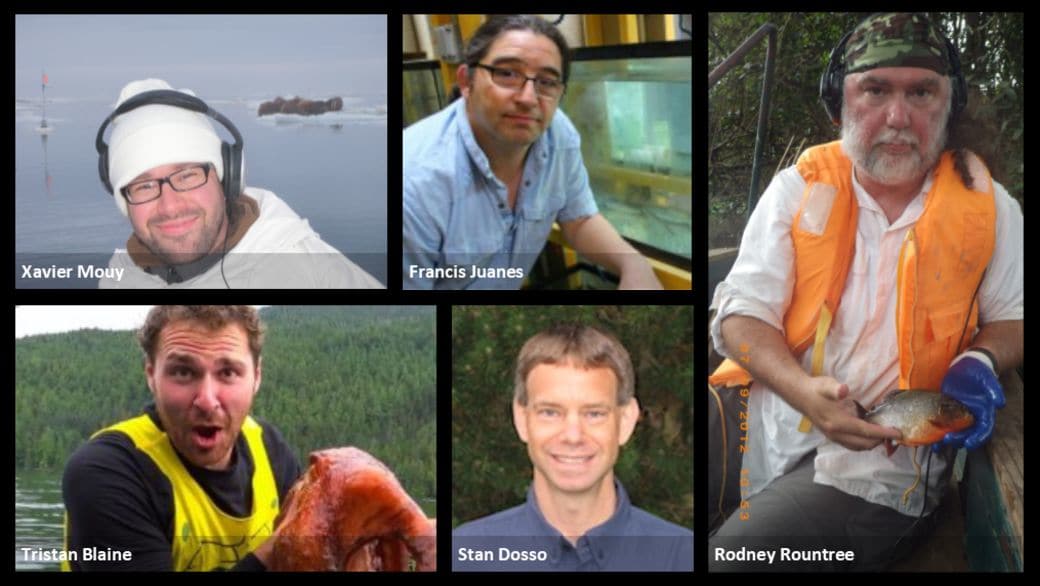
From the engineering of the instruments, selection of the study sites, to the analysis and interpretation of the data, this expedition touches on many research fields. Each member of the team brings a unique set of skills that is essential for putting all the pieces of the puzzle together.

Xavier Mouy, MSc
Xavier is a PhD student in acoustics at the University of Victoria, Canada, and a project scientist in the environmental consulting company JASCO Applied Sciences. He is leading this expedition as part of his PhD thesis supervised by Dr. Francis Juanes and Dr. Stan Dosso. Xavier comes with 10 years of experience in the industry developing tools for automatically detecting, classifying and localizing marine mammals sounds. He is keen to help making passive acoustics a viable tool for monitoring fish in British Columbia.

Francis Juanes, PhD
Francis is the Liber Ero Chair for Fisheries Research and a Professor at the University of Victoria. He is a specialist on the behaviour, ecology and evolution of fishes and marine invertebrates. His research also includes the use of marine soundscapes as a tool for conservation. He is at the head of many research projects in British Columbia dealing with the impact of noise on endangered southern resident killer whales and their prey. His wealth of knowledge and experience on fish ecology and biology are key for all the phases of this project.

Stan Dosso, PhD
Stan is a Professor in geophysics and ocean acoustics at the University of Victoria and the director of the School of Earth and Oceans Sciences. He is a worldwide expert in Bayesian inverse methods and has developed state-of-the-art algorithms for geoacoustic inversion. He has worked on many different topics ranging from estimating geoacoustic properties of the ocean bottom in the high Arctic, analysing earthquakes off British Columbia, to tracking bowhead whales and walruses using passive acoustics. Stan’s expertise is fundamental for the analysis of the acoustic data collected by our hydrophones.

Rodney Rountree, PhD
Rodney is an independent fish ecologist based in Cape Cod, Massachusetts and visiting scientist in the biology department at the University of Victoria. He is an expert on fish habitat use, behavior and trophic ecology, but you might also know him as the Fish Listener. He is one of the pioneers in the field of fish bioacoustics and has over 20 years experience in the identification and analysis of fish sounds around the world, from piranhas in the Amazon River to haddock in the Gulf of Maine. Rodney brings his expertise with fish sounds and the application of passive acoustics to fisheries science to the team.

Tristan Blaine, BSc
Tristan is a biologist, commercial diver and field lead with the Central Coast Indigenous Resource Alliance (CCIRA). He has extensive field experience and spends most of his time underwater surveying rockfish, herring and crab habitat. He knows more than anyone else where to find the different species of fish in British Columbia. His knowledge of the coastal waters of British Columbia and his field experience are essential for selecting our study sites and facilitating the logistics of the expedition.
Picture
0 Comments

The Fish Sound Project

10/10/2018

0 Comments

 
​“Prrrrr… thump… thump… brrrrr…”, these are the sounds you can hear in the coastal waters of British Columbia. Sounds the fish can make to scare away predators or attract mates. Yes, you read correctly, fish make sounds! And it has been known for a very long time. Aristotle was already describing these intriguing sounds in the 4th Century BC. Despite this, we still don’t know very much about the different types of sounds fish make and what they use them for. Currently, we know that about 800 species of fishes worldwide produce sounds. Among the approximately 400 known marine fish species frequenting the waters of British Columbia, only 22 have been reported to produce sounds so far. It is believed that many more of these species produce sounds, but their acoustic repertoires have not been identified yet and this is exactly what this project is about: Exploring the coastal waters of British Columbia to record and identify the sounds produced by the various fish species frequenting these waters.

Why do we care? The fish sound catalog we are building will allow us to monitor fishes over long time periods and large geographic areas in a completely non-intrusive manner, just by listening to the ocean. This will constitute an important tool for marine conservation and fisheries management.

How will we proceed? Fish don’t behave the same in a fish tank as in the wild. This is why we will record fish sounds directly in their natural environment. To identify fish sounds to specific species and behavior, we need to have our eyes and ears underwater. We need to know exactly where the sounds come from to pin-point which fish is producing them. Acoustic recorders equipped with hydrophones can be used as our ears and underwater video cameras as ours eye. Using several hydrophones, we can precisely localize the origin of the sounds in three dimensions.

Due to the complexity and the diversity of fish habitats, two different instrument systems will be used. For areas with a relatively flat seafloor, we will use a compact autonomous array composed of 6 hydrophones and 2 underwater cameras. This fixed system will be deployed on the seafloor for up to 1 week at each location. For steep seafloor slopes and complex habitats such as boulders, we will use a Trident ROV equipped with 2 hydrophones. This mobile platform will be employed for short-term missions (few hours).

There are several technical challenges associated with this project. For the fixed observing platform, one of the biggest challenges is that there are no off-the-shelf autonomous camera systems that can record for several days in a row. Consequently, we will design our own using a low-cost Raspberry Pi single board computer. For the mobile platform, the challenges reside in integrating the hydrophones to the Trident ROV.

Currently, we are building a prototype of underwater camera (pressure housing and electronics) and will be testing it in the next few days.
0 Comments
Forward>>

    Author

    Xavier Mouy is an acoustician and PhD student at the University of Victoria. He is leading the Fish Sound Project.

    Archives

    April 2020
    March 2020
    August 2019
    July 2019
    June 2019
    January 2019
    December 2018
    November 2018
    October 2018

    RSS Feed

Powered by Create your own unique website with customizable templates.
  • Home
  • Research
  • Publications
  • Science communication
  • The fish Sound Project Blog
  • Contact
